
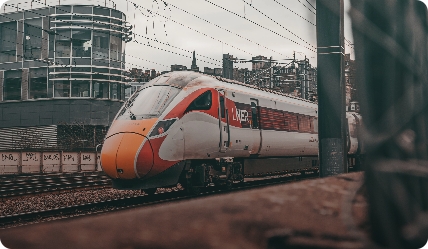
Always on the right track
Sensor solutions from Hansford Sensors and ASC
Vibration and Oscillation Monitoring in Rail Transport
Highly accurate measurement of oscillations and vibrations on vehicles and infrastructure is a fundamental requirement for safe and comfortable rail transport. Sensors play a central role in the development, construction, and operation of trains, as well as in monitoring systems for tracks, switches, and bridges.
The optimisation of line capacities and the increasing volume of rail traffic require systems that can respond quickly to disruptions. The evaluation of oscillations and vibrations is not only used to assess the current condition of vehicles, but also enables early detection of future material weaknesses. Corrective measures can be implemented before cost intensive damage occurs.
Measurement data can be transmitted in real time and made available digitally, forming the basis for digital twin applications. This relies on robust sensor solutions combined with intelligent algorithms for processing vibration and oscillation data.
Challenges in Rail Applications
Rail vehicles, particularly bogies, axles, brakes, and wheel bearings, are exposed to extreme mechanical loads. These components are designed and tested in accordance with the EN 13749 standard.
During testing, trains travel thousands of kilometres under harsh conditions, where impacts of up to four hundred g are not uncommon, especially when testing wheelsets and bogies. As these forces also act on the sensors, vibration sensors must be exceptionally robust, long term stable, and reliable.
Evolution of Sensor Requirements in Rail Operations
Historically, vibration sensors in rail applications were primarily used on test trains. These systems measured parameters such as track position and vertical acceleration to identify geometric errors in the track superstructure. This information helped plan and schedule maintenance activities.
However, test runs and subsequent data evaluation only provide insight into vehicle or track condition after a delay. Continuous monitoring during regular operation allows potential weaknesses to be identified much earlier, making a significant contribution to the safety and reliability of rail vehicles.
Digitalisation and Continuous Monitoring in Rail Networks
The adoption of digital technologies across the rail sector is increasing capacity, efficiency, and quality of rail networks. Sensors enable real time transmission and decentralised access to condition data, allowing operators to track the exact status of fleets and infrastructure at any time.
Sensors are no longer limited to test trains. They are now integrated into high speed trains, regional trains, trams, underground systems, and suburban railways. As a result, sensors must meet the requirements of DIN EN 50155 and IEC 60751 standards.
This shift has increased demand for cost effective, industrial grade sensors suitable for large scale deployment.
Partnership for Rail Approved Sensor Development
The development of an industrial piezoelectric IEPE acceleration sensor with railway approval brought together two sensor specialists.
ASC GmbH, a leading manufacturer of MEMS based inertial sensors for demanding test and measurement applications, partnered with Hansford Sensors, experts in the design and manufacture of industrial vibration sensors.
Hansford Sensors provided flexibility in sensor design, allowing sensor properties to be tailored specifically to rail approval requirements. While Hansford Sensors adapted the OEM sensor technology, ASC focused on system design, certification, and overall implementation.
Technology Used in Rail Vibration Sensors
Modern acceleration sensors typically use a piezoelectric operating principle. While shear technology is common, compression technology offers advantages in rail applications.
Compression sensors are better suited for continuous exposure to high amplitude impacts. Their sandwich style construction is mechanically robust and less sensitive to micro cracks compared to shear based designs.
The development was based on existing piezoelectric acceleration sensors with side and top connector options. These sensors already utilised compression technology and provided a strong foundation for adaptation to fatigue testing and rail specific requirements.
Operating Conditions on Rail Vehicles
Bogie assemblies absorb not only the weight of rail vehicles but also all forces acting on wheels and bearings. Track guided operation results in material wear, including rail defects and flat spots on wheel tyres.
High speed cornering generates additional loads on wheelsets, leading to increased bearing friction and wear. Differences between rail spacing and axle dimensions also result in accelerations caused by sinusoidal movement.
If accelerations exceed critical values, derailment can occur in extreme cases. Reliable vibration monitoring of bogies allows early identification of damage development, enabling preventive maintenance and avoiding unexpected failures.
Construction and Railway Approval
The objective was to develop a cost effective, mass market IEPE acceleration sensor suitable for continuous use in traffic trains.
The core of the sensor is an OEM capsule already used in industrial IEPE sensors. This technology provides a wide frequency range from zero point five hertz to seventeen kilohertz, multiple measuring ranges from plus or minus sixteen g to plus or minus eight hundred g, and shock resistance up to five thousand g.
Reliability is essential for rail use. With a calculated mean time to failure of two hundred and fifty thousand hours, equivalent to approximately twenty eight and a half years, the sensor meets long term operational requirements.
The sensor housing was developed specifically for rail environments. It is hermetically sealed, manufactured from robust stainless steel, and meets strict vibration and shock test criteria. With an IP68 rating, it withstands dirt, moisture, stone impact, and temperature extremes.
All technical design features were fixed during development and validated through testing to EN 50155. Close cooperation between ASC and Hansford Sensors ensured correct integration of OEM sensor capsules into railway specific housings.
Mounting and Installation Considerations
Conventional IEPE sensors are often mounted using a single fixing point, which offers no redundancy. Rail applications require more robust mounting solutions.
Rail specific sensors use permanently integrated cables that are fire resistant, halogen free, flame retardant, and resistant to temperature, UV exposure, and ozone.
Additional mechanical interfaces are avoided wherever possible, as material transitions can affect frequency response and introduce measurement errors. Housing design also enables selection of the sensitive measurement direction, eliminating the need for additional brackets or mounting adapters.
Outlook for Rail Sensor Development
The market launch of the mass market IEPE acceleration sensor for rail applications was planned for the first half of twenty twenty one.
Knowledge gained during development continues to inform future projects, including additional electrical interfaces, alternative power supply options, and new sensor designs.
Through collaboration with rail vehicle manufacturers, Hansford Sensors continues to optimise its portfolio and contribute to the ongoing advancement of vibration monitoring in the rail sector.


